
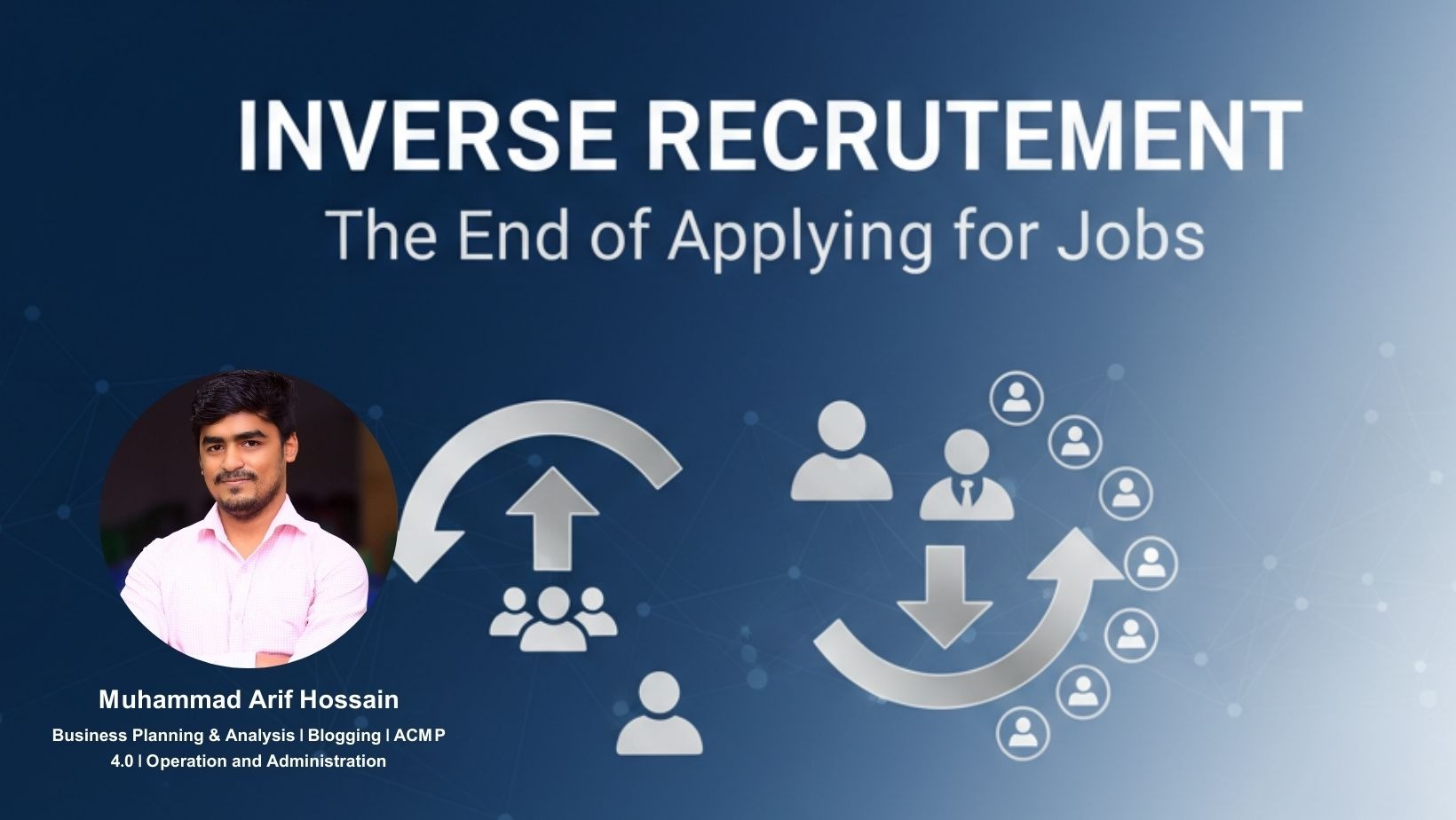
The traditional mechanics of talent acquisition are undergoing a systemic collapse. For decades, the employment market operated on a specific, inefficient protocol: candidates pushed static documents (resumes) into applicant tracking systems, hoping to pass through keyword filters. However, by 2026, this “Apply Now” paradigm is effectively becoming obsolete. The global workforce is witnessing the consolidation of Inverse Recruitment, a fundamental market shift where the act of searching for employment is replaced by the passive state of being identified by autonomous systems.
This transition marks the end of the “Push” economy, where labor pushes applications toward capital. It is being replaced by a “Pull” economy, where autonomous agents and artificial intelligence in recruitment scrape the digital ecosystem to identify, verify, and engage talent without human initiation. This is not merely a trend; it is the industrialization of headhunting, made possible by the maturity of agentic AI and decentralized identity verification.
The infrastructure for this shift is currently being deployed by major technology platforms. As hiring moves away from manual submission and toward algorithmic discovery, professionals relying on traditional resume optimization strategies risk invisibility in the modern marketplace.
The Collapse of the Resume-Based System
To understand the inevitability of Inverse Recruitment, one must examine the failure of the preceding model. By late 2024, the signal-to-noise ratio in recruitment had deteriorated significantly. The widespread accessibility of Generative AI tools allowed candidates to manufacture optimized cover letters and resumes at scale. Consequently, recruitment channels were inundated with high-volume, low-fidelity applications.
The resume, once a trusted proxy for competence, lost its utility as a verification tool. When a document can be perfectly synthesized by an algorithm, it ceases to be a reliable indicator of human capability.
In response, the market is correcting itself. In 2026, the primary filter for employment is no longer text-based claims; it is verified evidence. The “Application Phase” is being deprecated in favor of the Continuous Audit, where specialized algorithms monitor professional output in real-time to identify suitable candidates before a job vacancy is even publicly listed.
Pillar 1: The Agent-to-Agent Economy
The most significant operational change in 2026 is the removal of humans from the initial negotiation layer. The job market is evolving into a protocol economy driven by “Agent-to-Agent” interactions.
In this model, professionals utilize “Career Agents”, private AI models trained on their specific work history, compensation requirements, and cultural preferences. These agents act as digital proxies, operating continuously in the background. Instead of a professional manually browsing job boards, their Career Agent negotiates directly with Corporate Recruitment Agents.
This automated negotiation follows a distinct logic:
- Discovery: The Corporate Agent identifies a potential match based on verified skills data.
- Negotiation: The Career Agent receives the ping and cross-references the opportunity against the professional’s hard limits (e.g., salary floor, remote work policies, ethical constraints).
- Filtering: Negotiations regarding benefits, hours, and scope occur entirely between algorithms.
Only when a “High-Probability Match” is established, meaning both compensation and logistical requirements are met, are the human parties notified. This eliminates the administrative friction of scheduling and preliminary screening, allowing human interaction to be reserved for high-value cultural assessment.
Pillar 2: Proof-of-Work Over Keywords
In an environment where text is easily manufactured, trust is established through Verifiable Output. Inverse Recruitment relies heavily on “Proof-of-Work” protocols rather than self-reported skills.
Algorithms now prioritize raw data over curated summaries:
- Engineering: Evaluation is based on commit frequency, code quality, and open-source contributions hosted on platforms like GitHub.
- Creative Fields: Metadata within portfolio files is analyzed to verify workflow and originality.
- Strategic Roles: Blockchain-verified ledgers of project outcomes and attribution metrics replace bullet points on a CV.
Employers increasingly utilize “Forensic AI” to audit these digital footprints. These systems analyze the process of creation, not just the final output. By cross-referencing team compositions, project timelines, and public collaboration logs, these tools can distinguish between a candidate who led a project and one who simply observed it. Visibility in this new economy requires a shift from claiming skills to demonstrating them through personal branding and accessible digital repositories.
Pillar 3: Identity Verification and the Deepfake Defense
The rise of remote recruitment introduced significant security vulnerabilities, specifically the use of real-time AI avatars and “whisper agents” designed to assist candidates during interviews. By 2026, this has triggered a counter-response in the form of rigorous Identity Assurance.
The first stage of human interaction now frequently involves a “Liveness Test” or a biometric challenge. Candidates may be required to solve problems in a secured, real-time environment that tracks cursor movements and keystroke dynamics to ensure authenticity.
While this may appear invasive, it serves to restore meritocracy. It filters out “AI-Wrappers”, individuals relying entirely on generative tools to perform tasks they cannot execute independently. This ensures that the Inverse Recruitment model rewards genuine capability rather than technological manipulation.
The Autonomous Recruitment Workflow
To illustrate the mechanics of this system, consider the workflow for a Project Manager role in this modernized economy. The process is continuous, data-driven, and largely automated.
Phase 1: Continuous Profiling The professional maintains a “Career Vault”, a decentralized, encrypted profile. As projects are completed, performance metrics are automatically appended to this ledger. There is no manual “update” of a resume; the record evolves in real-time.
Phase 2: Algorithmic Matching A hiring entity’s AI scans the market for specific competencies, for example, “Fintech experience with a focus on risk mitigation.” The algorithm bypasses active job seekers and identifies a passive professional whose Career Vault data matches the requirement with 92% accuracy.
Phase 3: Smart Contract Authorization The Corporate Agent requests access to specific, relevant data slices from the professional’s profile. The professional’s Career Agent grants temporary, read-only access to verify the claims via a smart contract, ensuring data privacy is maintained.
Phase 4: The “Vibe Check” Once the data is verified and salary parameters are agreed upon by the agents, a calendar invitation is generated for a human meeting. The conversation bypasses basic competency questions, focusing immediately on strategic alignment and team dynamics.
The “Dark Forest” of Digital Hiring
The transition to Inverse Recruitment creates a distinct stratification in the workforce: The Signal-Rich versus The Signal-Poor.
Professionals in roles that naturally generate digital artifacts (software development, digital marketing, content creation) possess a distinct advantage. Their work leaves a trail that algorithms can easily follow. However, those in “low-signal” professions, such as manual logistics, high-security government work, or roles governed by strict Non-Disclosure Agreements (NDAs), face the risk of invisibility.
Furthermore, there is the risk of “Algorithmic Pigeonholing.” Predictive models rely on historical data, potentially trapping professionals in a loop of similar roles. For individuals looking to pivot industries, this presents a unique challenge. Identifying the best jobs for career changers requires a deliberate strategy to “train” the recommendation engines. Professionals must actively create new types of data signals, such as completing certification courses or publishing articles in the new field, to break the algorithm’s historical bias.
To mitigate privacy concerns, the market is adopting “Proxy Portfolios.” These are anonymized case studies that allow professionals to demonstrate logic and problem-solving methodologies without revealing proprietary data. Additionally, “Zero-Knowledge Proof” platforms are emerging, allowing a third party to verify that a professional worked for a high-profile client without revealing the client’s identity to the public web.
Strategic Adaptation for the 2026 Market
Adapting to an environment where application buttons are obsolete requires a shift in professional strategy. Success depends on curating a digital presence that acts as a beacon for recruitment algorithms.
Transitioning from Application to Publication
The primary asset for a professional is no longer the Curriculum Vitae, but the Public Repository.
- Documentation: Professionals must document methodologies, case studies, and genericized project wins on public platforms.
- Discoverability: An empty search result for a professional’s name is viewed as a lack of verification. The objective is to create a data trail that confirms expertise.
Auditing the Digital Twin
Search engines and professional networks constitute a “Digital Twin.” Recruitment algorithms analyze this twin to categorize potential candidates.
- Consistency: Skills listed on professional networks must be substantiated by engagement, posts, or validated projects. Discrepancies between stated skills and observed activity result in a lower “trust score” within hiring algorithms.
- Curation: Irrelevant or “low-signal” content (purely social interactions) creates noise that can confuse matching systems.
Embracing Asynchronous Vetting
The preliminary interview is increasingly being replaced by Paid Micro-Projects. Organizations prefer to commission a small, standalone task, auditing a landing page or reviewing a code snippet, to verify ability. Professionals must be prepared to execute work samples on demand, treating them as the primary gateway to employment.
Conclusion: Efficiency and Human Connection
While the mechanics of Inverse Recruitment are technological, the outcome is fundamentally human-centric. The current recruitment model is burdened by administrative fatigue, repetitive forms, automated rejections, and scheduling inefficiencies.
By offloading the “Searching,” “Filtering,” and “Negotiating” phases to artificial intelligence, the industry removes the drudgery of the process. Inverse Recruitment ensures that when human interaction finally occurs, it is meaningful, informed, and focused on potential rather than logistics. The future of employment is not about humans competing against machines; it is about utilizing machines to facilitate precise, meritocratic human connection.


One thought on “Inverse Recruitment: The End of Applying for Jobs”